teachFoundry
17. Rate of reactions
17. Rate of reactions
Couldn't load pickup availability
Rate of Reactions: Complete Kinetics Mastery Notes & Worksheet Bundle
Stop Guessing the Graphs. Master Collision Theory.
Why do students lose marks on Rate of Reactions? It’s rarely because they don't know that heating a reaction makes it faster. It’s because examiners are incredibly strict about the exact phrasing required to explain why it happens. If you forget to mention "frequency of effective collisions" or the "number of particles with energy greater than or equal to the activation energy," you miss out on full marks.
Furthermore, analyzing reaction graphs—interpreting why a curve flattens out or sketching how a curve shifts when a variable changes—trips up thousands of students every year. Our Rate of Reactions Master Bundle replaces the guesswork with a flawless framework for analyzing kinetics data and writing point-scoring explanations.
What’s Included in This Digital Pack?
1. High-Yield Revision Notes (PDF)
-
The 5 Factors of Reaction Rates: A deep, comprehensive breakdown of how Temperature, Concentration, Pressure, Surface Area, and Catalysts alter reaction speeds.
-
The Collision Theory Template: Learn the exact structural keywords examiners look for when grading long-answer questions. Never lose marks again for vague explanations of particle behavior.
-
Graph Interpretation Blueprint: A definitive guide to reading rate graphs (Volume/Mass vs. Time). Learn exactly how to determine when a reaction is fastest, when it is slowing down, when it has stopped, and how the total yield is determined by the limiting reactant.
-
Experimental Setups Decoded: Step-by-step visual guides showing the laboratory apparatus setups used to measure rates, including gas syringe collection (volume) and electronic balance tracking (mass loss).
2. Exam-Ready Practice Worksheet (PDF + Answer Key)
-
Graph Modification Challenges: Exercises where students must sketch a second curve onto an existing graph to reflect a change in conditions (e.g., doubling the concentration or using a catalyst).
-
Collision Theory Keyword Drills: Structured writing prompts designed to build muscle memory for using terms like "kinetic energy," "successful collisions," and "alternative reaction pathway."
-
Data and Rate Calculations: Practice calculating the average rate of a reaction over a specific time interval using data tables and graphs.
-
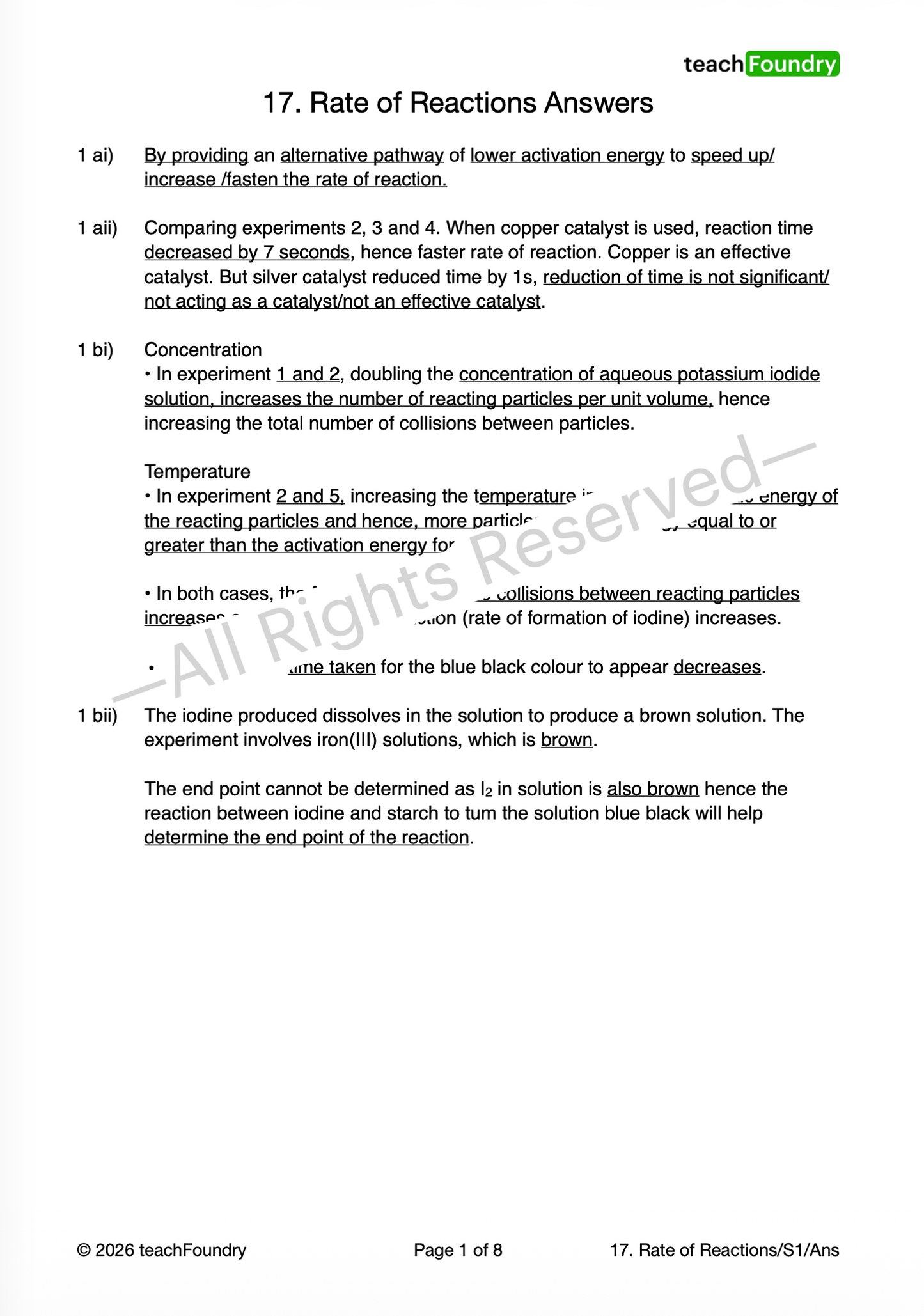
Full Step-by-Step Solutions: Every single graph and written explanation features a completely worked out solution path, highlighting the precise marking scheme keywords in bold.
Why These Notes Get Results:
-
Syllabus Aligned: Rigorously optimized for the current Cambridge IGCSE (0620), O-Level (6092/5070), AQA, and Edexcel international specifications.
-
Visual-First Layout: Features clean, color-coded rate curves, particle collision diagrams, and structured summary tables rather than dense walls of textbook text.
-
Digital Stationery Friendly: High-resolution, scalable PDFs optimized beautifully for GoodNotes, Notability, or Samsung Notes on iPads and tablets.
-
Instant Access: Secure checkout with an immediate download link sent to your inbox—no waiting for physical shipping.
Student & Tutor Review
"Sketching the altered rate curves on exam graphs used to confuse my students every single time. The graph interpretation blueprint in this packet broke down the logic perfectly—showing how initial gradient changes but final height depends entirely on moles. It's a game changer for Paper 4 preparation!" — Mr. Kevin Y., Chemistry Lead Tutor
Product Specifications:
-
Format: 1 x Comprehensive Revision Notes PDFs, 4 x MCQs with Answer PDFs and 3 x Structured Questions with Fully Solved Solutions PDFs.
-
Price: $13.50
[DOWNLOAD NOW & MASTER RATE OF REACTIONS]
Share