teachFoundry
6. Pressure
6. Pressure
Couldn't load pickup availability
Pressure: Complete Solid, Liquid & Atmospheric Pressure Mastery Bundle
Stop Confusing Force and Pressure. Master the Fluid Mechanics.
Why do students lose marks on Pressure? It’s rarely because they don't know that pressure equals force divided by area. It’s because examiners love to test force distribution and depth variables—forcing students to calculate the maximum and minimum pressure of a rectangular block, explain why dams are built thicker at the bottom, or read complex liquid levels on U-tube manometers.
Failing to convert units accurately (like shifting from cm2 to m2) or forgetting to add atmospheric pressure to liquid pressure will instantly destroy a student's score. Our Pressure Master Bundle replaces textbook confusion with an ironclad, highly visual problem-solving framework.
What’s Included in This Digital Pack?
1. High-Yield Revision Notes (PDF)
-
The Solid Pressure Blueprint: Master the core mechanics of surface distribution:
P = F/ALearn exactly how to calculate the minimum and maximum pressure of an object by manipulating its contact surface orientation.
-
Pressure in Liquids (Hydrostatic) Matrix: Learn how pressure acts in fluids and master the depth equation:
P = hρgUnderstand why liquid pressure depends only on depth, density, and gravity—not the shape of the container.
-
Barometers & Atmospheric Pressure Decoded: A clear visual guide to how mercury barometers work. Learn how to read atmospheric pressure changes at sea level versus high altitudes and identify what happens when a vacuum is compromised.
-
Manometer Gas Pressure Engine: A step-by-step framework for analyzing U-tube manometers. Learn how to look at the shifting liquid levels and effortlessly calculate the pressure of an enclosed gas supply using:
Pgas = Patm ± hρg
2. Exam-Ready Practice Worksheet (PDF + Answer Key)
-
The "Area Trap" Unit Conversion Drills: High-volume practice problems specifically designed to train students to convert cm2 to m2 flawlessly without getting tripped up by the scaling factor.
-
Maximum vs. Minimum Pressure Layouts: Geometric challenges requiring students to find the highest and lowest pressure a heavy crate exerts on the ground based on its dimensions.
-
Manometer Level Prediction Tables: Scenarios where students are given pressure data and must calculate the exact height difference (Δh) of the liquid column or vice versa.
-
Real-World Qualitative Prompts: Practice writing point-scoring explanations for classic exam scenarios: why snowshoes stop you from sinking, why sharp knives cut better, and how hydraulic brakes work.
-
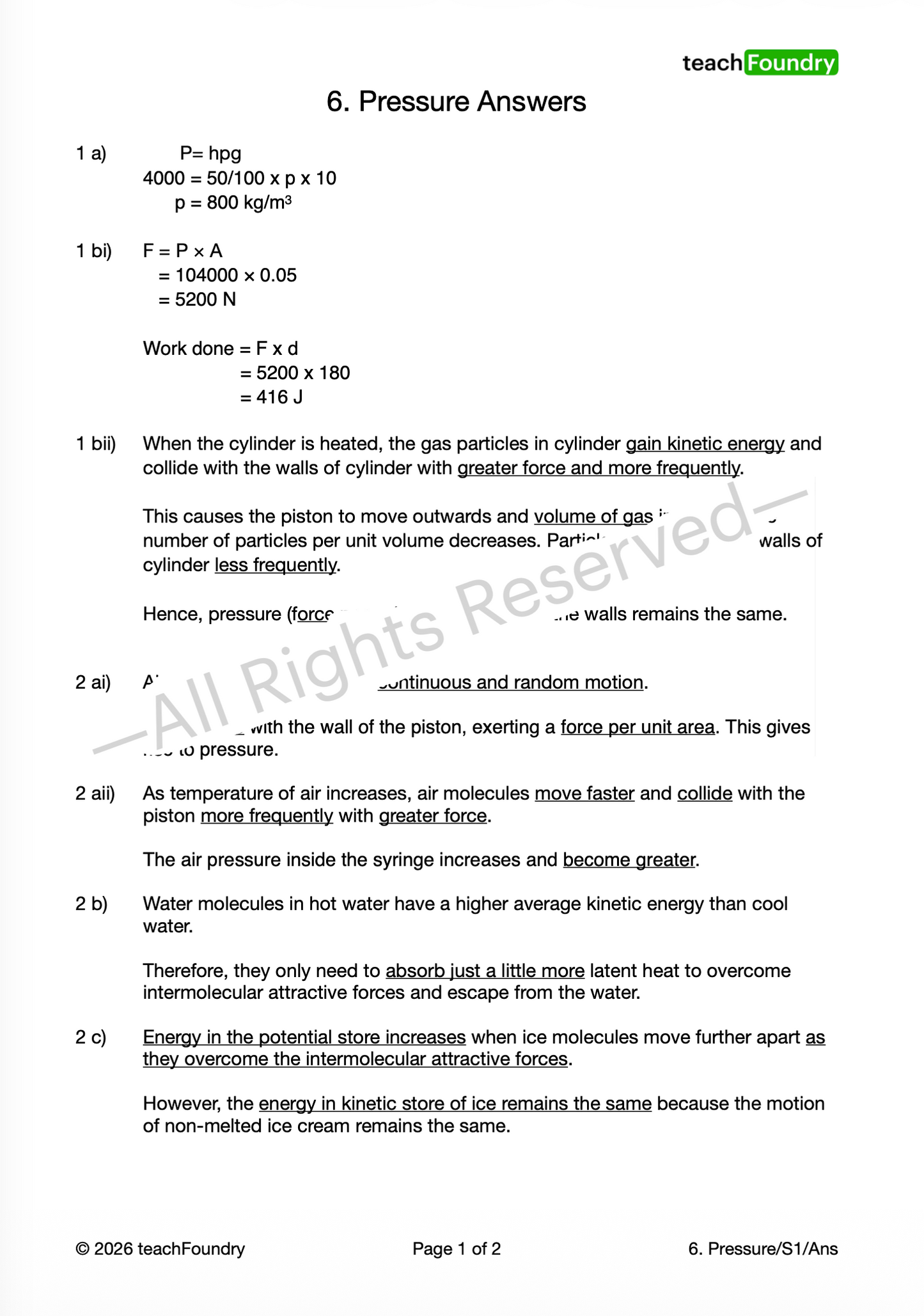
Full Step-by-Step Solutions: Every single fluid diagram and algebraic transposition features a fully written-out working path, showing exactly where hidden variables (like atmospheric pressure) must be factored in.
Why These Notes Get Results:
-
Syllabus Aligned: Rigorously optimized for the current Cambridge IGCSE (0625), O-Level (6091/5054), AQA, and Edexcel international specifications.
-
Visual-First Layout: Replaces long, dry blocks of text with high-contrast mercury column schematics, U-tube pressure vectors, and step-by-step mathematical workflows.
-
Digital Stationery Friendly: High-resolution, scalable PDFs optimized beautifully for GoodNotes, Notability, or Samsung Notes on iPads and tablets.
-
Instant Access: Secure checkout with an immediate download link sent to your inbox—no waiting for physical shipping.
Student & Tutor Review
"Reading manometers used to be a complete guessing game for my students—they never knew whether to add or subtract the liquid column height. The simple pressure balance templates in this pack solved it instantly. The unit conversion page is worth the price alone!" — Mr. Daniel T., IGCSE Physics Tutor
Product Specifications:
-
Format: 1 x Comprehensive Revision Notes PDFs, 2 x MCQs with Answer PDFs and 2 x Structured Questions with Fully Solved Solutions PDFs.
-
Price: $9.90
[DOWNLOAD NOW & MASTER PRESSURE]
Share