teachFoundry
10. Linear Law
10. Linear Law
Couldn't load pickup availability
Mastering Linear Law: Additional Mathematics Topical Worksheet Pack
The Blueprint for Non-Linear Data Transformation. Conquer Experimental Graphs, Gradient Mappings, and Constant Conversions.
In elementary mathematics, students are accustomed to straight-line graphs that are straightforward and predictable. You calculate a basic gradient, read the y-intercept, and the relationship is fully mapped out.
Additional Mathematics (A-Math) introduces a major real-world challenge with Linear Law. In scientific experiments and advanced engineering, variables rarely relate to each other in a clean, linear straight line. Instead, they warp into complex curves, exponential growth arcs, or inverse hyperbola shapes (e.g., y=axb or y=Abx). Linear Law is the mathematical art of using algebraic transformations to take a wildly curved graph and force it onto a straight-line coordinate plane (Y=mX+C).
This topic acts as a heavy cross-curricular gatekeeper. Examiners love this chapter because it checks multiple core skills simultaneously: laws of logarithms, index rules, structural graph reading, and coordinate manipulation. A single arithmetic error while calculating the gradient from an experimental log scale or a failure to correctly match the capital "Y" axis expression will instantly break a high-weightage 10-mark exam question.
Our Linear Law Topical Worksheet Pack is systematically engineered to replace confusing trial-and-error transformations with clean, predictable, and repeatable algebraic workflows. This digital workbook trains students to convert any non-linear model into an exact straight-line format with flawless accuracy.
What’s Inside the Pack?
This digital archive contains 3 highly targeted modules designed to build complete mastery from baseline variable isolation up to advanced, unstructured examination challenges:
Module 1: Transforming Algebraic Non-Linear Models
Mastering the algebraic mechanics required to convert radical, fractional, and polynomial curves into straight lines.
-
Transforming rational curves such as y=ax2+bx into the linear form xy=ax+b, where xy is plotted against x.
-
Managing inverse systems like y=xa+b or y1=ax+b to identify the correct vertical intercept (C) and gradient (m).
-
Training muscle memory to isolate the isolated constant term to form the C component of the standard Y=mX+C template.
Module 2: Transforming Exponential & Logarithmic Curves
Conquering the high-yield exam profiles where variables are trapped high up in exponential power grids.
-
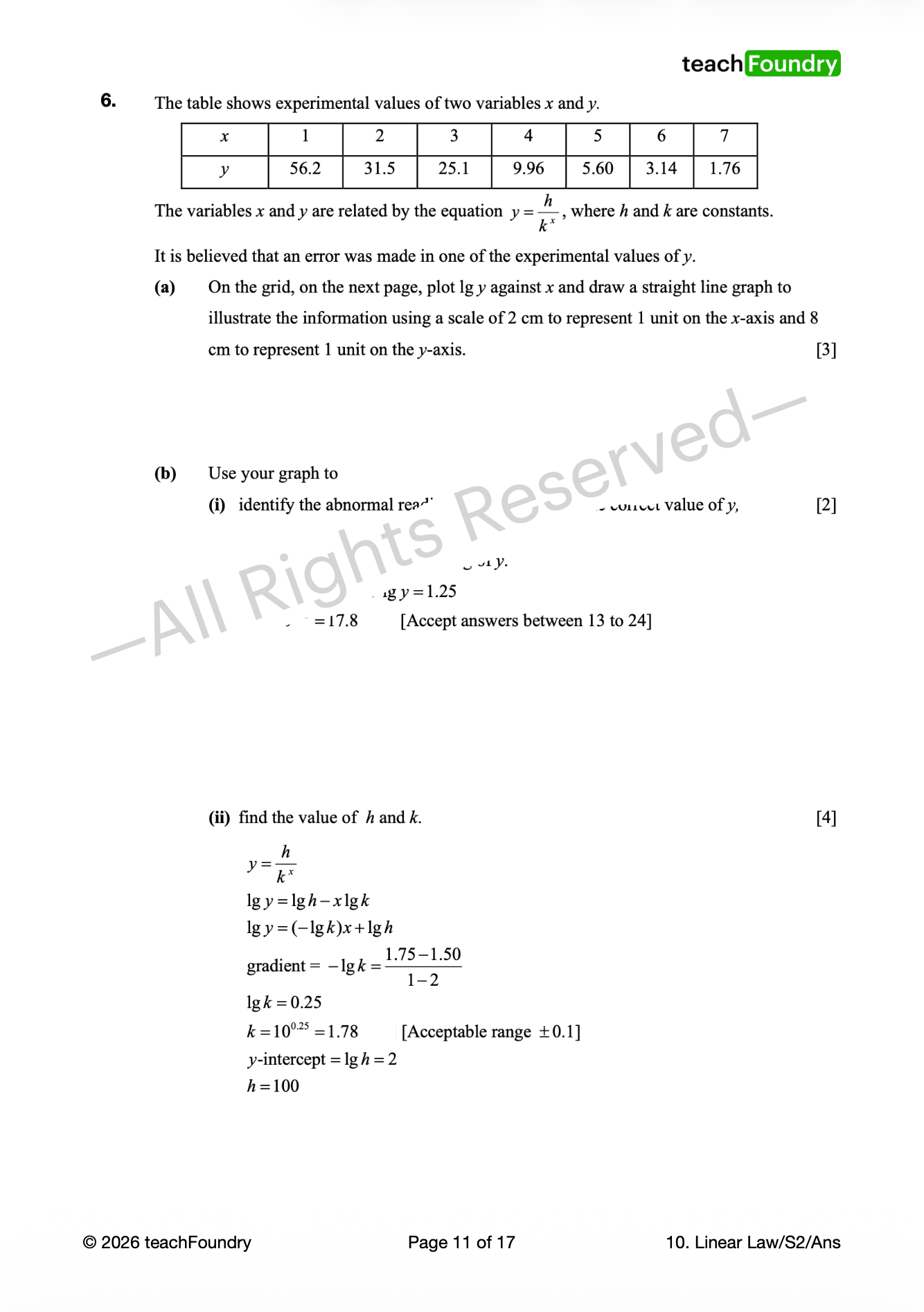
Applying the laws of logarithms to transform power functions (y=axb) into linear straight lines: lgy=blgx+lga.
-
Transforming exponential population models (y=Abx) using natural or base-10 logs into lny=(lnb)x+lnA.
-
Harmonizing equations with mixed bases to ensure constants can be cleanly extracted from the straight-line graph components.
Module 3: Extracting Constants from Linearized Plots
Developing the reverse-engineering skills required to decode a straight-line graph back into its original curved formula.
-
Calculating the exact gradient (m) of a linearized line using custom coordinate pairs like (lgx1,lgy1).
-
Converting the straight line's vertical intercept (C) back into its non-linear structural form using anti-logarithms (a=10C or a=eC).
-
Solving for missing coordinate points along the straight line when given the underlying operational formula.
Key Features for High-Performance Learning
📲 Digital Stationery & Print Ready: High-resolution, searchable vector PDFs designed to look completely crisp on standard A4 paper or inside tablet annotation apps like GoodNotes, Notability, and Samsung Notes.
-
Progressive 3-Tier Scaffolding: Problem sets systematically climb from Tier 1 (Algebraic Transformation Drills) to Tier 2 (Logarithmic Base Conversions & Variable Mappings) up to Tier 3 (Unstructured Experimental Graph Exam Simulations).
-
"Zero-Skipped-Steps" Solution Keys: We do not believe in lazy, single-number answer keys. Every single question features its full algebraic layout—showing exactly how logs are distributed, how the axes parameters are defined, and how the constants are extracted step-by-step.
-
Command-Word Calibrated: Every problem explicitly mirrors authentic international paper command phrasing ("Express the equation in a form suitable for plotting a straight line...", "State what variables must be plotted on the axes...", "Hence, estimate the value of the constants...").
Product Specifications:
-
Format: 2 x Comprehensive Revision Worksheets PDFs with Fully Solved Solutions PDFs.
-
Price: $9.90
[DOWNLOAD THE MASTER LINEAR LAW VAULT AND LINEARIZE WITH CONFIDENCE TODAY]
Share